
From first viewing to split commission, without a spreadsheet.
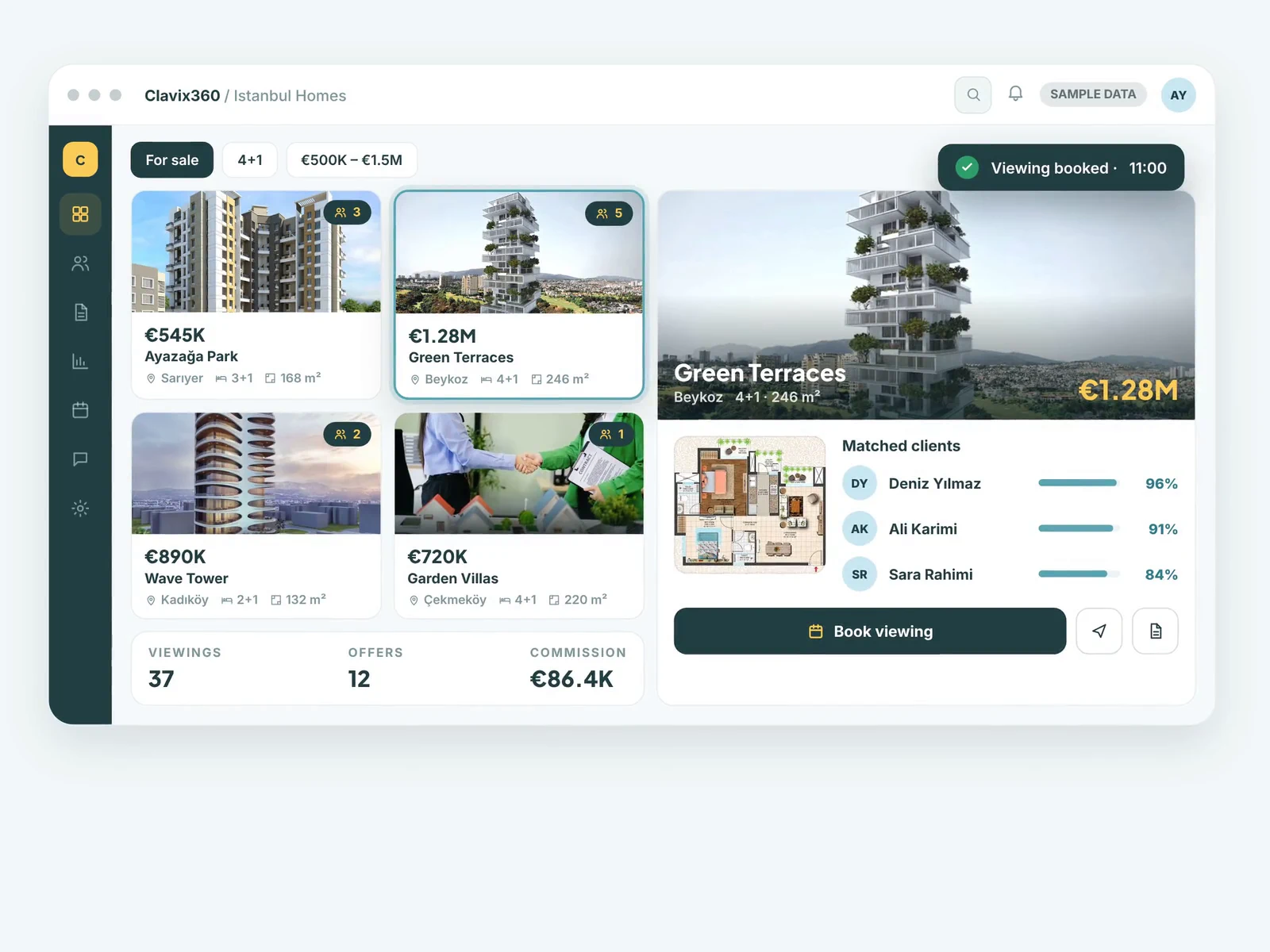
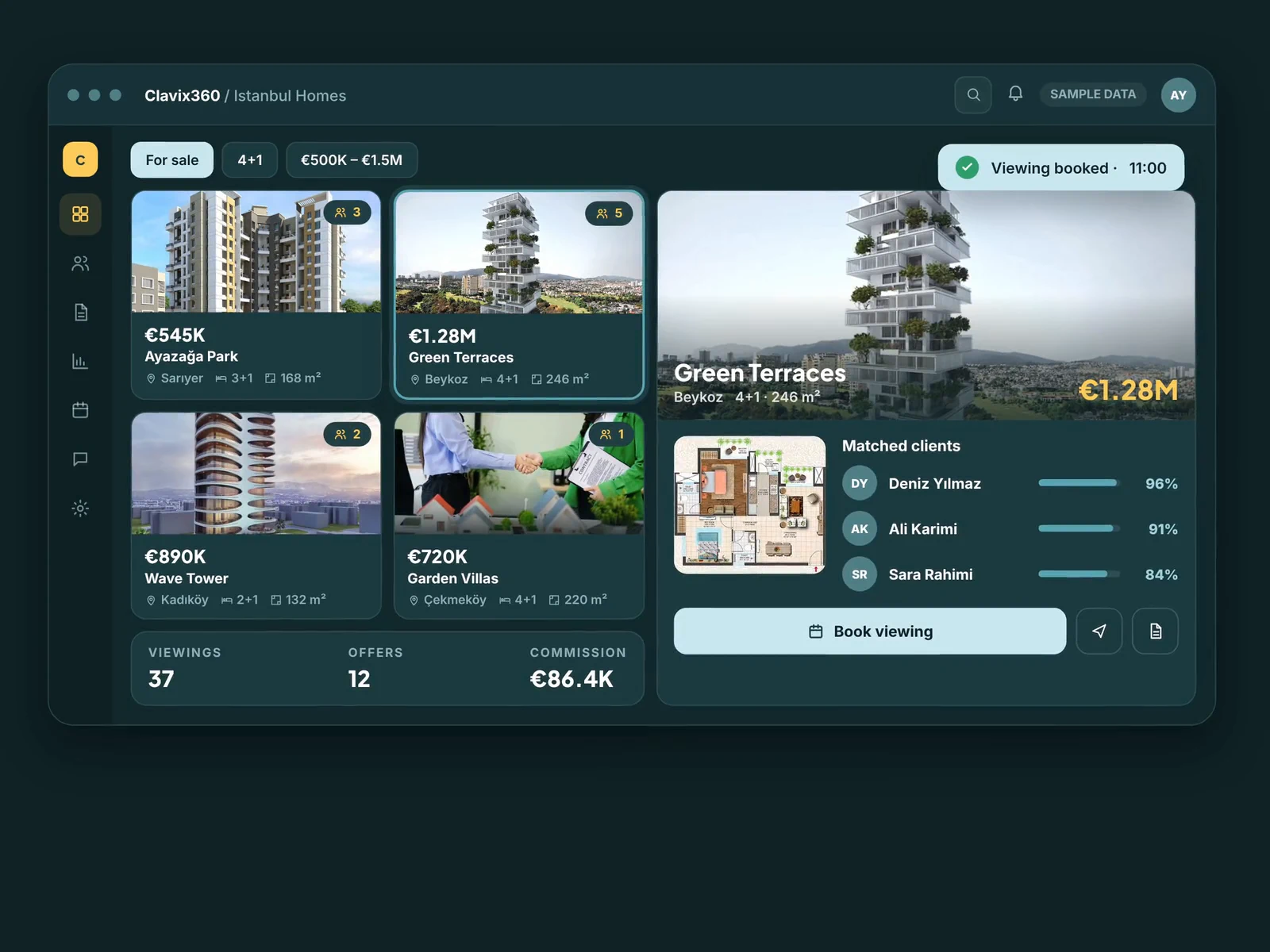
Listings, viewings, offers and deals in one pipeline — with commission calculated the way your agency actually splits it.
Your best leads are leaking before you even see them.
Most agencies are not losing deals to competition — they are losing them to friction.
Leads scattered across five channels
WhatsApp, Instagram, email, walk-ins — and nobody owning the follow-up.
Commissions calculated by hand
Argument-prone splits between agents, manager and the agency.
Viewings missed or double-booked
Nobody can see the day's viewings in one place, so agents and buyers walk away.
Owner blind on real numbers
You only learn the month was bad on the first of the next one.
Lead, visit, offer, deal.
The flow every agent already runs in their head — now a screen they can see.
Lead
Owned by an agent the moment it arrives. No silent leads.
Visit
Viewings booked against the listing, the client and the agent.
Offer
Recorded against the listing and tracked to a decision.
Deal
Commissions split, finance booked, after-sales started.
Built for the agency that wants to grow.
The features your agents have been asking for — already inside.
Listings & inventory
One clean catalogue of every property, with statuses that update live.
Leads, calls & viewings
Capture, assign and follow up — every viewing owned by a named agent.
Agent commission splits
Configurable splits that calculate themselves the moment a deal closes.
Offers tracked to a decision
Every offer against its listing and its client, from submitted to accepted.
After-sales follow-up
Past clients become future commissions when you keep the door open.
Real estate pipeline
Stage-by-stage visibility for the owner and the team lead.
Most agencies pay for a CRM, a spreadsheet habit, an HR tool, a reporting tool and a meeting tool. All of it is already inside. From €1,548 a year, plus a one-time setup.
Every department, one platform
Marketing spends the budget, agents work the lead, operations delivers the viewing, finance books the split. People and intelligence sit across all of it.
- SalesPipeline by stage and by agent · Viewings owned, with follow-up tasks that resurface when overdue · Won, lost and parked stages on every client · KPI per agent, live
- MarketingCampaigns and budgets · Spend by channel · Cost per campaign, tracked · Budget against the period's result
- FinanceIncome against real cost · Commission calculated, not guessed · Splits by agent, manager and agency · Margin and ROI by period
- PeopleRoles and permissions · Tasks and approvals · Team KPI and workload · Agent performance, ranked
- IntelligenceLive BI dashboards · Conversion by stage · Agent ranking by revenue · Profit and loss, current
AI
AI reads your numbers
- AI strategy read on your live numbers
- Performance by property type and by area
- Margin, ROI and days on market, explained
Know who is loyal, and who you are losing.
Every buyer and every agent has a history. The system keeps it — who is still moving, who went quiet, and who is carrying the month.
Loyal buyers
Clients still active on the books, and the agent who owns each one.
Top agents
Who actually closes, ranked by the revenue they brought in.
Lost buyers
Parked and lost clients kept on the record, with the agent's notes.
Quiet agents
Performance dropping, surfaced before it becomes a problem.
What this engine does not do yet.
The real estate engine is newer than construction. Here is what is missing, plainly, so you can judge it before a demo rather than during one. All three already work in another engine, so this is sequencing rather than a limit of the platform.
- Payments receivedCommission is calculated on every closed deal and split by role — agency, salesperson, supervisor, manager, director — from one company-wide structure. There is no place to record the money actually received against a deal yet.
- Bringing your portfolio inListings, leads and clients are entered in the platform and stay there. There is no spreadsheet import for real estate yet — construction and trade have one.
- Offers written by AIOffers are drafted, priced and sent from the platform. The AI that writes one from your own catalogue runs in the construction engine only, for now.
These are in development, and the order they arrive in is shaped by the people already using it. Tell us what your agency actually needs
What agencies ask us first.
Yes. Every lead, client and viewing is owned by a named agent, and salespeople, supervisors and sales managers are scoped to the projects they are assigned to — they see those and nothing else. Directors and administrators see the whole book. All of this is staff access inside your own environment; agencies you work with are records in the system, not logins.
You set one structure for the agency: a total commission percentage, then the share going to the agent, the supervisor, the sales manager and the director, plus what the company keeps and tax. Each share is validated so the parts can never exceed the whole, and every share starts at zero so nothing is owed until you enter your own numbers. The moment a deal's status moves to closed, the platform computes each person's amount and writes the rows.
Listings can be created and edited through the platform with type, category, price, currency, area, city and status, and each one carries its own reference. For a first load from a spreadsheet, our team does the import for you as part of setup rather than leaving you to paste rows in one at a time.
Offers are recorded against the listing, the client and the agent, and tracked through their statuses to a decision, so nothing is lost between a verbal yes and a signature. Branded one-page PDF documents are produced by the platform's offer builder, which today works from the client and property records rather than directly from a listing — if a branded PDF straight off a listing is important to you, tell us during setup.
We do it. We set up your workspace, migrate your existing data, train your agents on the real-estate engine, and stay available to you afterwards. Setup is a one-time fee charged at the start and never again; the subscription is separate from it.