
Know your margin before you commit the material.
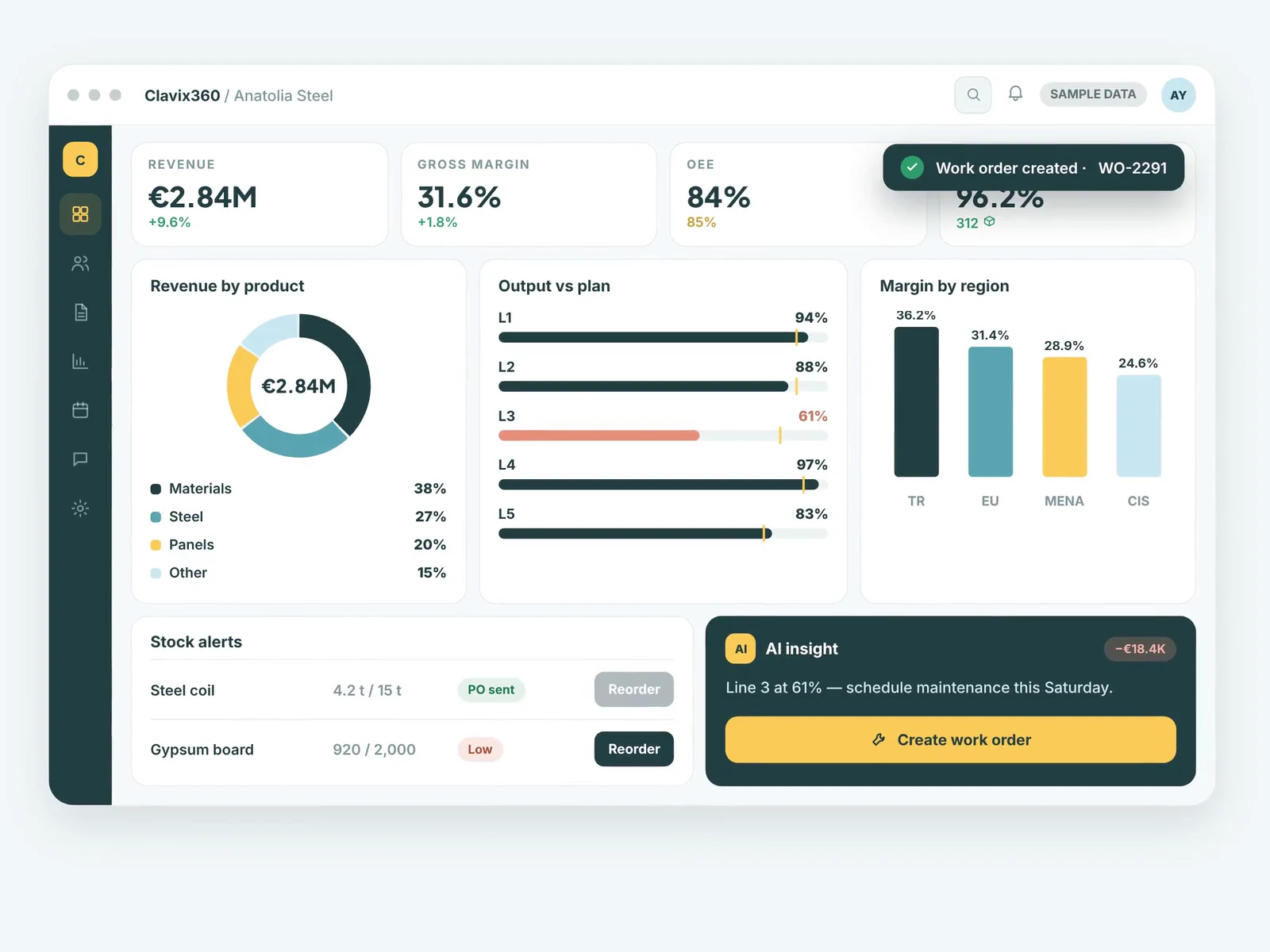
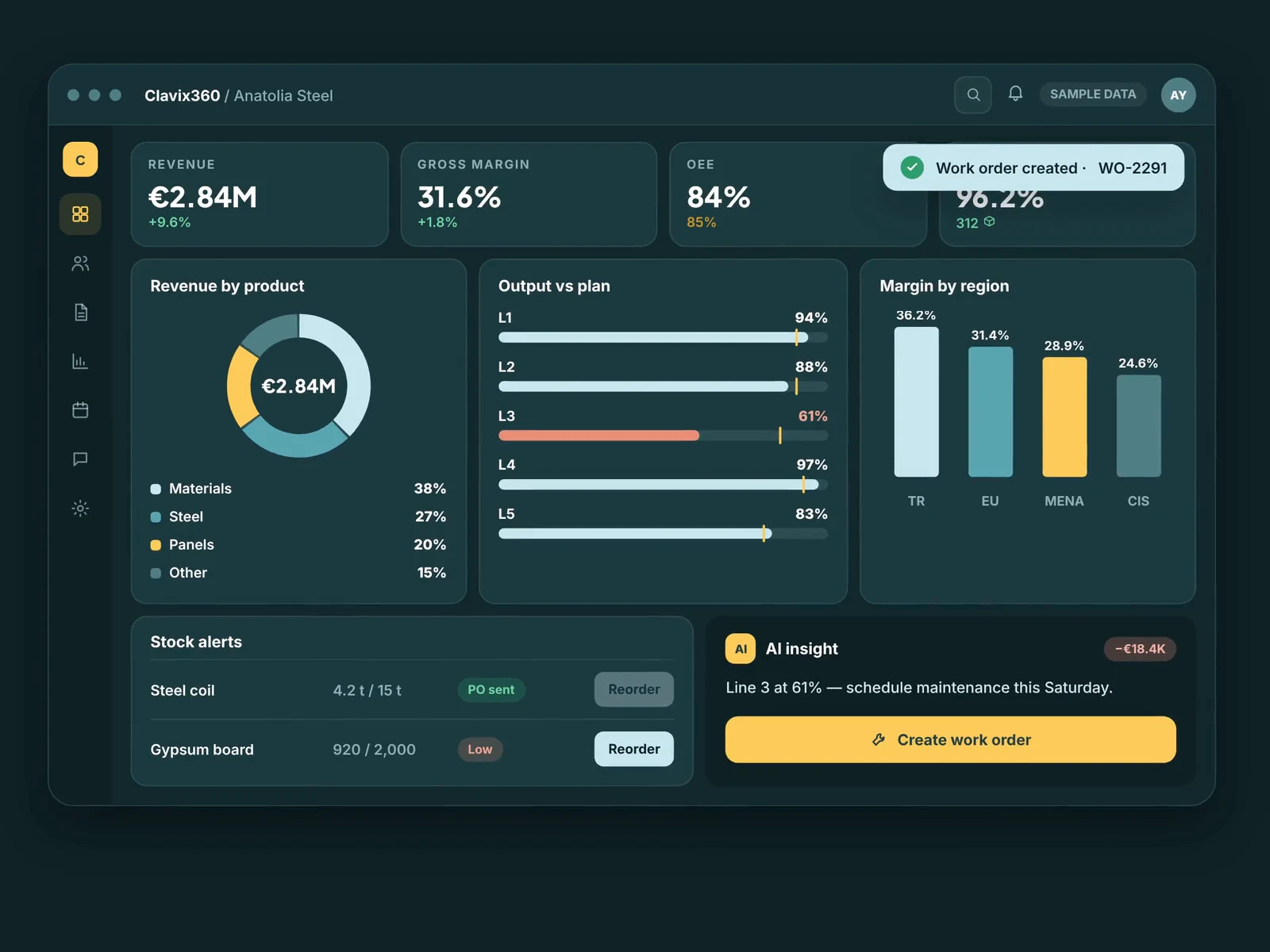
Purchase orders, production runs, stock and sales in one ledger — so margin is a number you see when you quote, not one you find out after.
Running on five tools is running on guesswork.
What scattered spreadsheets, WhatsApp and email actually cost a real business.
Five tools, zero source of truth
Sales in one place, stock in another, accounting in a third. Nothing reconciles.
Proforma chaos
Versions of the same offer floating around with different prices and terms.
Stock surprises
You confirm an order, then realise the stock is not there.
No live margin
You learn at month-end whether the deal was actually profitable.
Buyer, proforma, order, delivery, paid.
The five moves of every deal — one engine that moves with them.
Buyer
Buyers, history, terms and Incoterms in one record.
Proforma
Proforma documents issued in seconds — versioned.
Order
Confirm the order and stock moves with it, shortfalls flagged.
Delivery
Shipments tracked with method, ship-from and delivery date.
Paid
Payments logged, proof attached, cost of goods booked.
Built for businesses that want to grow without chaos.
The features that finally make the whole operation run on one engine.
Proforma & Incoterms
Proformas with the right Incoterm on the deal — EXW to DDP, and the currency with it.
Products & stock
Live stock that moves the moment you confirm, with every change on a ledger.
Suppliers & buyers
Both sides of the trade, with lead times, payment terms and a supplier rating you set.
Orders & delivery
Proforma to order to delivered to paid, with the method on every one.
Payments & arrears
Payments logged against every order, with proof attached and arrears visible.
Live KPI & reports
Margin per deal, per buyer, per category — without a single spreadsheet.
Most factories and trading businesses pay for a CRM, a spreadsheet habit, an HR tool, a reporting tool and a meeting tool. All of it is already inside. From €1,548 a year, plus a one-time setup.
Every department, one platform
Sales works the buyer, procurement fills the shelf, operations delivers it, finance collects. People and intelligence sit across all of it.
- SalesPipeline by stage and by salesperson · Follow-up dates on every buyer, with call history · Won, lost and parked, with the reason recorded · KPI per person, ranked by revenue closed
- FinanceRevenue against cost of goods · Commission calculated, not guessed · Payments, arrears and proof of payment · Profit and loss across the whole operation
- PeopleRoles and permissions · Tasks and approvals · Team KPI and workload · Performance per person, ranked
- IntelligenceLive dashboards on orders and stock · Revenue, cost of goods and gross profit · Margin by buyer and by category · Profit and loss, current
- Stock and supplyLive stock per product and warehouse · Purchase orders received straight into stock · Every movement on a traceable ledger · Low stock surfaced before you commit
Intelligence
Live dashboards on orders and stock
- Revenue, cost of goods and gross profit
- Margin by buyer and by category
- Profit and loss, current
Know who is loyal, and who you are losing.
Every buyer and every supplier has a history. The system keeps it — who keeps ordering, who delivers on time, and who has gone quiet.
Loyal buyers
Customers who came back, and what they buy.
Reliable suppliers
Lead times, payment terms and the rating your team gives them.
Lost buyers
Why they stopped, recorded against the buyer.
Quiet accounts
Buyers going silent, surfaced before they are gone.
What this engine does not do yet.
The manufacturing engine is the largest of the five, and still not finished. Here is what is missing, plainly, so you can judge it before a demo rather than during one. All three already work in another engine, so this is sequencing rather than a limit of the platform.
- One person's own numbersTeam performance is measured and reported. The per-person view — one seller's own figures, on their own screen — exists in construction and real estate, not here yet.
- AI over your own numbersProfit and loss is calculated from your own orders, costs and margins. The AI that reads that and tells you what changed is connected to the real estate and clinic engines, not this one yet.
- Offers written by AIQuotations and proformas are drafted, numbered and sent from here. The AI that writes one from your own catalogue runs in the construction engine only, for now.
These are in development, and the order they arrive in is shaped by the people already using it. Tell us what your factory actually needs
What factories and traders ask us first.
Yes to both. Every order and every proforma carries its own currency, and the Incoterm is a validated field on the order — EXW, FCA, FOB, CIF, CFR, DAP, DDP and DPU. Each supplier also carries a default Incoterm and payment terms, so the right basis is already on the record when you raise the deal.
The moment a proforma is confirmed into an order, stock for each line is decremented and a movement is written to the inventory ledger against that order. Nothing is silent: if a line takes a product below zero, the confirmation returns a warning naming the product and the shortfall. It warns rather than blocks, so a deal is never held hostage by a stock count that has not been updated yet — but the shortfall is on screen, not discovered later.
Yes. There are dedicated importers for both, each with a parser and a validator that check the file before anything is written, so bad rows are reported rather than half-loaded. For the first load our team runs it with you as part of setup.
Each product carries a cost price and a sale price. When orders are confirmed, the reporting engine joins the order lines back to product cost to produce cost of goods, and reports revenue, cost of goods and gross profit for the period, broken down by buyer and by category. To be precise about where it appears: margin is a reporting figure, not a field on the proforma — the proforma itself carries quantities and prices, and the cost side is applied when the numbers are reported.
We do it. We set up your workspace, migrate your existing products, buyers and suppliers, train your team on the engine that matches your business, and stay available to you afterwards. Setup is a one-time fee charged at the start and never again; the subscription is separate from it.